
Slitting Stainless Steel: Why It Is Harder Than Mild Steel
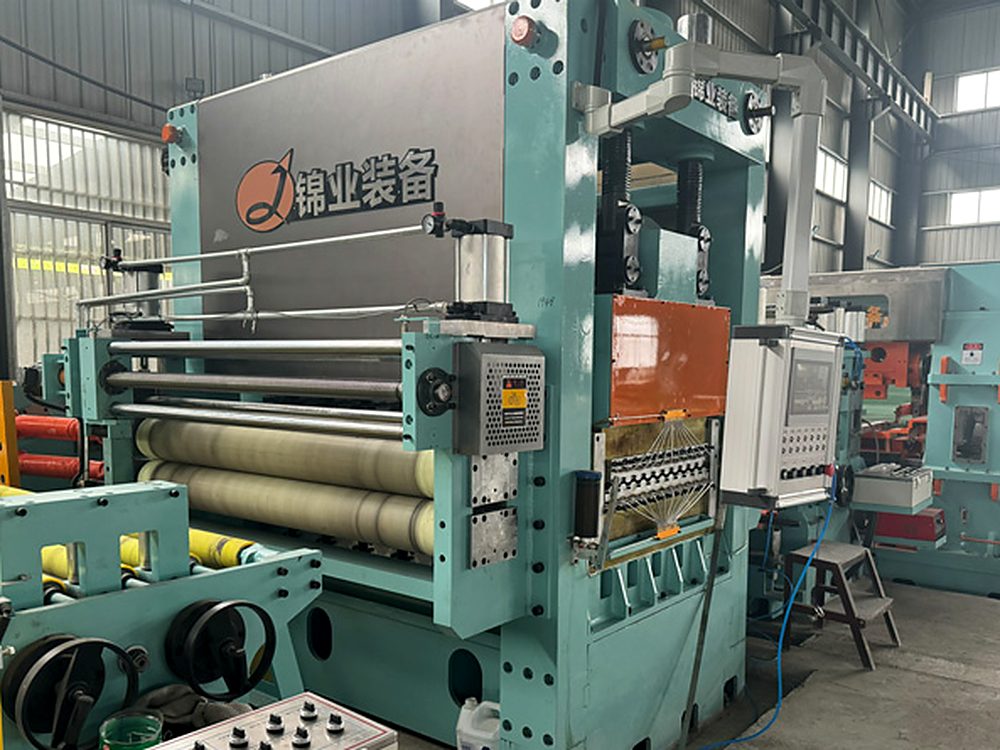
Stainless steel is harder to slit than mild steel at the same thickness for three reasons: it work hardens as it is cut, it needs more cutting force, and its surface marks if anything touches it. A line that handles 1.5 mm cold rolled steel comfortably will struggle with 1.5 mm 304 unless the mandrel, the tension and the roll covers are specified for it.
Work hardening at the blade edge
When stainless is sheared, the material next to the cut deforms and hardens. The next cut passes through harder material, and the one after that through harder material again. On a long run the blade is not cutting the same strip the coil started as — it is cutting an edge that has been progressively hardened by every previous pass through the slitter.
The visible result is burr that starts within tolerance and climbs. The invisible result is blade wear concentrated at the cutting edge rather than distributed across the face, which is why stainless slitting consumes blades faster than the tonnage alone would suggest.
More force for the same thickness
Type 304 sits around 205 MPa yield but work hardens rapidly; 430 is higher at roughly 345 MPa and less ductile. Either way, the shear force per millimetre of thickness is higher than mild steel, and it rises as the material hardens through the line.
That force goes into the mandrel, the housings and the gearbox. A light mandrel that is adequate for 1.5 mm mild steel will deflect under 1.5 mm stainless, and mandrel deflection shows up as uneven strip width across the coil — tight at the ends, wide in the middle, or the reverse depending on where the load lands.
Pick-up, galling and the burr that will not settle
Stainless has a tendency to pick up on the blade: small particles of the strip weld to the cutting edge under pressure, and the edge then tears rather than shears. The signature is a burr that is rough and irregular rather than tall and even, often on one strip only, and it gets worse as the blade heats up.
Three things control it. Blade material with enough hot hardness and low affinity for the work — the choice between T10, H13, HM-3 and 6CrW2Si is set out in the blade material note. Lubrication applied at the cut rather than upstream of it. And clearance that is checked against the actual gauge, not set once and left.
Surface finish is part of the specification
2B, BA and No.4 finishes are sold on appearance, so a scratch is a reject. Everything that touches the strip is a potential scratch: the peeler, the hold-down, the side guides, the leveler rolls, the tension rolls and the recoiler mandrel.
- Roll covers — polyurethane or rubber on contact rolls, and no bare steel where the strip is under tension.
- Guide surfaces — non-marking inserts at the side guides, and guides that are set to the strip width rather than left wide.
- Protective film — if the coil arrives filmed, the line must handle the film without lifting it at the edges, and the trim has to take film and metal together.
- Cleanliness — stainless picks up carbon contamination from mild steel dust. A line that also runs carbon steel needs a cleaning routine between materials.
Tension is higher, not lower
A common assumption is that stainless, being harder, should be run at lower tension to avoid marking. In practice it needs more tension than mild steel of the same gauge to keep the slit strips flat and separately wound, because the material is stronger and resists conforming to the mandrel.
More tension means a recoiler sized for it, a tension system that holds it steadily, and a pressure roll that does not mark the surface while applying it. Under-tensioned stainless produces tower build-up and loose coils that are damaged before they leave the line.
Scrap is worth more, so handle it properly
Stainless edge trim has real scrap value, and mixing it with carbon steel scrap destroys that value. A separate scrap winder for the trim, kept clean between materials, is not a luxury on a stainless line — it is the difference between selling scrap at stainless price and at mixed price.
What to specify for a stainless slitting line
- Grade and finish — 304, 316L, 430, 2B, BA or No.4, and whether the coil is filmed.
- Thickness and width range, plus the gauge you run most.
- Burr limit as a share of thickness, and whether the strip goes to a press or a roll former.
- Tension requirement implied by the strip width and the recoil diameter.
- Surface protection — which rolls need covers, and how the line is cleaned between materials.
- Scrap segregation — separate winder and container for stainless trim.
Stainless lines in the slitting line range run from 0.3 mm to 12 mm, and the differences from a carbon steel line are in the mandrel stiffness, the roll covers, the tension capacity and the blade specification — not in a different control system.
If you are moving from carbon steel to stainless on an existing line, send the grade, the finish and the gauge band. The gap between what the line can hold and what the customer will accept is usually measurable before any steel is cut.
More from the workshop
Related news
Industry News
What Decides Cut to Length Accuracy on a Coil Line?
Length error comes from the measuring roll, the leveler, shear response and the stacker — where each one costs you millimetres, and what to specify.
Read more
Industry News
Flying, Rotary, Swing or Stop Shear: Choosing a CTL Shear
Stop, swing, rotary or flying: how thickness, speed and surface finish decide which shear a cut to length line is built around.
Read more
Industry News
Burr and Camber in Slit Strip: What the Tolerances Mean
Burr is a share of thickness and camber is millimetres per metre — how each is measured, what causes it, and which one the slitter owns.
Read moreTalk to us
Working on a line like this one?
Tell us the coil or sheet you need to produce. We will come back with the configuration, the working range and the delivery schedule that fit your project.
- Material grade, thickness and coil width
- Finished strip width or cut length
- Target output and site conditions